

The post-COVID-19 office: possible solutions
The arrival and repercussions of remote working have called into question the role of the office as we knew it before the pandemic. What purpose will it serve now? While remote working has proven that people can be productive at home, it has also shown that it does not meet all employees’ needs, especially those related to collaboration and interaction. But what needs will the post-COVID office have to meet? As interior designers, we always aim to understand the needs of the users of the spaces we design—it’s an integral part of our process. Our expertise allows us to propose solutions that attempt to meet the needs that are generally felt at the moment, and that is what I propose to present in this article.
Between motivation and profitability
Vacant or underutilized office space is now a real challenge for employers. Finding solutions that will both encourage employees to return to the office and, at the same time, make their square footage profitable is certainly a priority for many.
Key trends to consider in post-COVID-19 office design
While it is true that every layout must reflect the specific needs of those who use it, we are nonetheless witnessing the emergence of major trends that will be decisive in post-COVID-19 office design. Beyond the continued use of unassigned workstations, which remain advantageous in a hybrid working model—and the greater storage needs associated with them—how will workspace be used?
Separate areas depending on the tasks to be performed
Post-COVID offices will need to promote fluidity and offer a variety of spaces, determined by the different tasks that employees need to perform. Knowing that the spaces will be well suited to their needs, in an environment conducive to interpersonal exchanges, employees will be more inclined to want to return to the office.
Spaces designed for productivity
Collaborative spaces—collaboration being the main objective of in-person workdays—will also need to be varied, sometimes formal (conference rooms), sometimes informal (lounges, coffee areas, small cubicles, etc.). In addition, there will need to be quiet areas: rest areas, work areas where phones are not allowed, for example, but where the presence of colleagues provides a sense of belonging to the group, or small enclosed spaces for concentrated work. Finally, spaces that incorporate digital collaboration tools, such as rooms designed for videoconferencing, will be essential to the smooth functioning of a hybrid work model.
 Modular and high-tech offices
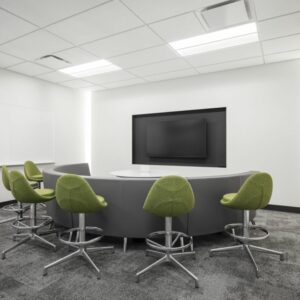
The pandemic has taught us that the unpredictable is to be expected and that the adaptability of spaces must now be considered paramount. The use of modular furniture is a good starting point. The need to include access to smart technologies throughout our post-COVID office spaces will also be essential.
What is the point of rethinking the post-COVID office?
What is the goal of all these post-COVID office design proposals? Employee well-being. Redesigning spaces according to tasks means ensuring that the environment is conducive to performing a specific job and promoting user well-being. At the same time, it allows individuals to develop a sense of belonging to their company, which in turn will have an impact on employee retention rates.
To each his own space
However, we cannot stress this enough: one size does not fit all! It is essential to understand the specific needs of our employees in order to provide them with an inspiring, productive environment that promotes their well-being. There is no benefit in creating spaces that do not contribute to anything. With this in mind, employers will need to be more attentive and flexible than ever before.