
The evolution of workspaces: a long-standing phenomenon
A previous article discussed the impact of the work revolution on interior designers and, more specifically, the reflections that arise from these changes. We are witnessing a period of upheaval that is affecting major trends in workplace and office design.
Designs that have made history
However, this wave of office redefinition is nothing new. I find the clear correlation between societal changes and their impact on the world of work, and consequently on design, particularly interesting. The history and organization of work have shaped, and continue to shape, our conception of the office. In this article, I therefore offer an overview of the trends that clearly demonstrate the evolution of workspaces since the early 1900s.
Taylorism and hierarchical spatialization
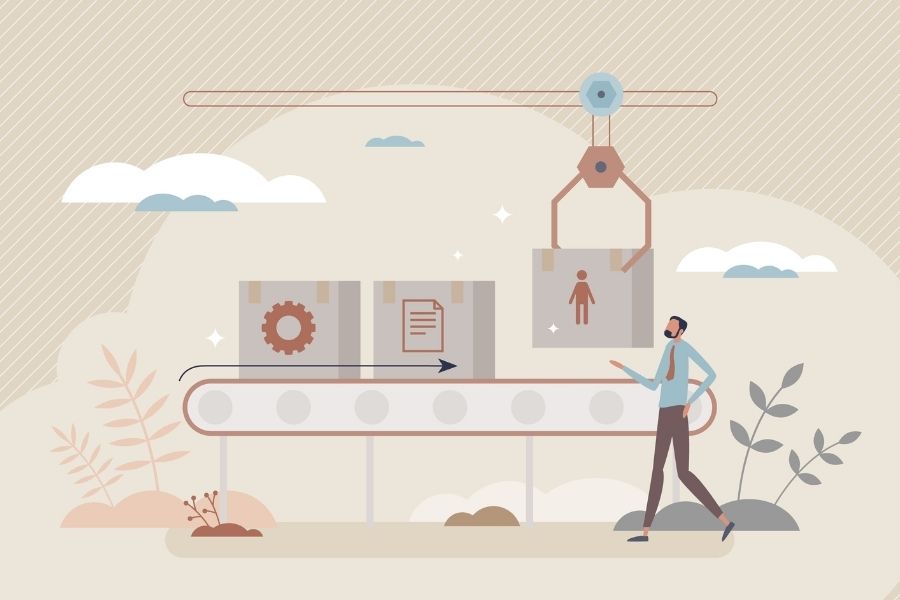
At the beginning of the last century, and until about halfway through, Taylorism had a significant influence on the organization of work, which had only one goal: efficiency. Rationality and productivity were the order of the day, and workers occupied a workspace determined by their job functions. The office was organized according to a very rigid hierarchy.
The evolution of workspaces toward a more social-democratic model
The changes in mindset that defined the post-war period and the economic growth linked to reconstruction led to organizational models that advocated for a democratization of the office. This gave rise to an anti-hierarchical model that aimed to promote greater collaboration and communication between workers, all brought together in a large open-plan space. Gradually, this model evolved into a similar model that aimed to increase the customization of workspaces and provide greater privacy for workers.
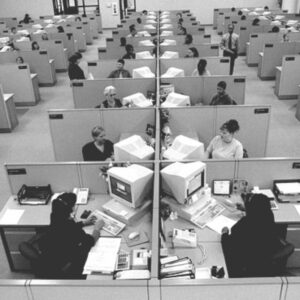
The 1970s: the era of cubicles
From the 1970s to the 2000s, the open-plan office persisted, but with a considerable increase in the use of furniture to separate workstations: cubicles became the norm. This concept was based on the principle that people were more productive in a customizable territorial enclave, but one that also allowed them to take part in surrounding activities.
Design in the 21st century
The early 2000s were marked by a certain “relaxation” in the office. With technology making considerable progress, offices became less cluttered. Greater attention was paid to workers’ health, and the workplace took on the air of a living space.
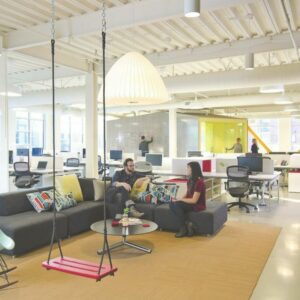 Since 2010, many changes have taken place and we can see that trends in office design are focused on flexibility and wellness, which is becoming increasingly important in society and lifestyles. Thanks to digitalization and the revolution brought about by the internet, workers can now work wherever they want. Offices are therefore adopting a more comfortable aesthetic. Furniture ergonomics, adequate lighting, and the inclusion of natural materials are all being optimized. Collaborative and “recreational” areas are becoming commonplace. Then came non-territorial offices, i.e., spaces with unassigned workstations that allow for greater square footage efficiency. And finally, we are seeing more and more co-working spaces emerge…
Workspace and office design: a reflection of the society
It is clear that workspaces are an excellent indicator of societal trends and that their evolution reflects continuous improvements in employee efficiency and well-being. When it comes to the future of office spaces, it is clear that the popularity of remote working resulting from the pandemic alone is forcing us to rethink their fundamental role. Employers today need to listen to their employees to fully understand their needs and expectations. And if there is one lesson to be learned from history, it is that the ideal workspaces are those that meet the expectations and needs of employees, not those of management.